

STEM Synapse

Latest in STEM

Today

  1. Paper of the DayAI & Machine LearningPreprint, not yet peer reviewed

    Fast Catch-Up, Late Switching: Optimal Batch Size Scheduling via Functional Scaling Laws

    Language models are trained on data fed in batches, and how large those batches should be at each stage is usually set by rule of thumb.

    Why it matters Language models can be trained on small batches for most of the run and switched to large ones late, saving data without losing quality.

    The researchers used a mathematical description of how training error falls over time to find the best batch-size schedule when the amount of data is fixed. For easy tasks the batch should keep growing; for hard ones it should stay small for most of training and jump to large only near the end. After that late switch the model quickly catches up, because the noise built up from small batches fades fast. Tests on models of up to 1.1 billion parameters showed late switching beat constant and early-switch schedules while using less data.

    Wang et al., arXiv cs.AI, 17 November 2026.

    Read the paper: Fast Catch-Up, Late Switching: Optimal Batch Size Scheduling via Functional Scaling Laws

  2. Paper of the DayChemistry & Materials Science

    Sulfurization Breaking the Ferroelectric Polarization Bottleneck in PbTiO3

    Ferroelectric materials hold an electric polarisation that can be flipped and kept without power, which makes them useful for memory chips.

    Why it matters Treating lead titanate films with sulfur nearly doubles the stored electric polarisation that ferroelectric memory relies on.

    Lead titanate should be one of the strongest, but electric current leaking through it has kept that strength from showing in practice. The researchers made thin films of it with a cheap solution-based method and then treated them with sulfur. Untreated films already performed well, and sulfur treatment raised the polarisation they kept to about 1.8 times its original value, while the material stayed ferroelectric at higher temperatures. Calculations suggest sulfur stretches the crystal in a way that favours the polar arrangement. The authors see the method as promising for ferroelectric devices.

    Pan et al., JACS, 17 November 2026. doi:10.1021/jacs.6c17201

    Read the paper: Sulfurization Breaking the Ferroelectric Polarization Bottleneck in PbTiO3

  3. Paper of the DayPsychology & Cognitive SciencePreprint, not yet peer reviewed

    From media to dreams: The effects of the Russo-Ukrainian war on threatening dream content in a Finnish dream diary sample

    One theory holds that dreams evolved to rehearse threats, especially those our ancestors faced, such as physical violence, more than threats like disease.

    Why it matters A distant war seen only through the news filled Finnish dreams with more threats of violence than pandemic lockdowns did.

    If so, war should change dreams more than a pandemic does. The researchers compared two Finnish dream-diary studies run the same way: 567 dreams from 45 people recorded after Russia's full-scale invasion of Ukraine, and 1,128 dreams from 85 people recorded under the strictest COVID-19 restrictions. Dreams after the invasion contained more threats, above all of physical aggression, even though participants knew the war only through the media. Dreams that mentioned war directly held the most such threats. The threats were not more severe, though, contrary to what the researchers expected.

    Loukola et al., PsyArXiv, 17 November 2026. doi:10.31234/osf.io/37rgk_v1

    Read the paper: From media to dreams: The effects of the Russo-Ukrainian war on threatening dream content in a Finnish dream diary sample

  4. Paper of the DayTech & EngineeringPreprint, not yet peer reviewed

    Adversarial Reinforcement Learning for Adaptive Eavesdropping in BB84 Quantum Key Distribution

    Quantum key distribution lets two parties share a secret code with a guarantee from physics: anyone listening in disturbs the signal in a way that shows up as extra errors.

    Why it matters An eavesdropper that learns from feedback can slip past the standard error check in quantum key distribution far more often than fixed attack models assume.

    Security checks usually assume the eavesdropper intercepts at a fixed rate. Here the eavesdropper was instead a simple learning program that watched the error rate and decided, one quantum bit at a time, whether to intercept. With 1% channel noise, it cut its chance of being detected from 99.4% under the best fixed strategy to about 0.28%, while still collecting around 10 correct key bits per round. The agents also learned to burst their attacks at the very end, a trick that randomised check timing removed.

    Bagunu, arXiv cs.CR, 17 November 2026.

    Read the paper: Adversarial Reinforcement Learning for Adaptive Eavesdropping in BB84 Quantum Key Distribution

  5. Paper of the DayBiology & Ecology

    Groundfish With Diverse Life Histories Increase in Size and Abundance With Proximity to Spatial Protections

    Closing patches of sea to fishing should let fish grow bigger and more numerous inside them and spill over into nearby waters, but that is hard to show in real data.

    Why it matters Fish protected from fishing off western Canada grow larger and more plentiful, and the gains reach nearby waters and build the longer protection lasts.

    The researchers used 18 years of surveys of 28 kinds of bottom-dwelling fish, collected by four Indigenous Nations on the Pacific coast of Canada, inside and up to 160 kilometres outside seven Rockfish Conservation Areas. Fish were largest and most abundant inside the protected areas and became bigger and more common closer to them, and these effects strengthened as the areas aged. Fast-breeding species increased in number sooner, as expected, but slow-breeding species grew larger sooner, the opposite of the prediction.

    Wilson et al., Ecology Letters, 17 November 2026. doi:10.1111/ele.70486

    Read the paper: Groundfish With Diverse Life Histories Increase in Size and Abundance With Proximity to Spatial Protections

  6. Paper of the DayMath & Computer Science FoundationsPreprint, not yet peer reviewed

    Minimum cores in lattice graphs: zonotope structure and quartic growth

    Picture an endless grid where each point is linked to every point within a set distance.

    Why it matters On grids, groups where every member has most of its links inside the group must be large, growing with the fourth power of link range.

    A core is a group of points in which every member has at least as many links inside the group as outside it, and the question is how small such a group can be. The author shows that every core's outline must include a particular many-sided shape fixed by the grid, and that on a flat grid the smallest core grows with the fourth power of the linking distance. When each point is linked only to its eight surrounding points, the smallest core has exactly 12 points. Finding cores in general networks is also shown to be computationally hard, settling an earlier conjecture.

    Mehrdad, arXiv cs.AI, 17 November 2026.

    Read the paper: Minimum cores in lattice graphs: zonotope structure and quartic growth

  7. James Webb Space Telescope view of N159, a star-forming region in the Large Magellanic Cloud.
    Space, Astronomy & Aerospace N159, a star-forming region in the Large Magellanic Cloud, seen by Webb ESA/Webb, CC BY. Added .
  8. Paper of the DaySpace, Astronomy & Aerospace

    Bayesian Inference of Stellar r-process Abundances

    Many elements heavier than iron, including gold and uranium, are made in the rapid neutron-capture process, a burst of nuclear reactions whose exact settings in space are still debated.

    Why it matters Heavy elements in old stars and in the Sun can be traced to just two kinds of neutron-capture conditions, mixed in different proportions.

    Old stars rich in these elements keep a record of it. The researchers built a statistical method that explains a star's pattern of elements as a mix of simulated production events, each with its own conditions. For one well-studied star, exactly two components were needed, one making the heavier elements and one the lighter ones, and adding more did not help. Two other old stars and the Sun's own heavy elements fit almost the same two components in different proportions, although the Sun's lightest heavy elements need an extra source.

    Kuske et al., Astrophysical Journal, 17 November 2026. doi:10.3847/1538-4357/aea6a7
    Read the paper: Bayesian Inference of Stellar r-process Abundances

  9. Paper of the DayHealth & Biomedical

    Semaglutide for the Treatment of Obesity in Children 6 to <12 Years of Age

    Semaglutide, a weekly injected drug, is approved for obesity in teenagers and adults, but there has been little evidence on whether it helps younger children.

    Why it matters A weekly obesity drug already used by teenagers and adults also lowers body-mass index substantially in children aged 6 to 11.

    In this trial, 167 children aged 6 to 11 with obesity were randomly given weekly semaglutide or a dummy injection for two years, and all of them received advice on lifestyle changes. After 68 weeks, body-mass index had fallen by 13.5% on average with semaglutide and risen by 2.7% with the dummy injection. The difference was still large at two years. Side effects were reported in nearly all children in both groups, those on semaglutide and those on the dummy injection.

    Buch et al., NEJM Current Issue, 16 November 2026. doi:10.1056/nejmoa2604058

    Read the paper: Semaglutide for the Treatment of Obesity in Children 6 to <12 Years of Age

  10. Paper of the DayPhysics

    Spin-Resolved Microscopy of ⁸⁷Sr SU(N) Fermi-Hubbard Systems

    Physicists study magnetism by trapping ultracold atoms in a grid made of laser light and photographing them one by one, but this has mostly used atoms with two spin states, the quantum property behind magnetism.

    Why it matters Single strontium-87 atoms can now be imaged along with which of their ten spin states each one holds, bringing exotic magnetism into view.

    Strontium-87 atoms have ten, which allows richer kinds of magnetism that have never been watched atom by atom. The researchers built a microscope for strontium-87 that sees single atoms and, using laser pulses that act on each spin state separately, records which of the ten states every atom is in from a single snapshot. They checked it by watching single atoms' spins turn in a magnetic field, and simulations show it should reveal how the spins of neighbouring atoms are linked.

    Gas-Ferrer et al., Physical Review X, 16 November 2026. doi:10.1103/v9sh-cq7r

    Read the paper: Spin-Resolved Microscopy of ⁸⁷Sr SU(N) Fermi-Hubbard Systems

  11. Orange-red tabular wulfenite crystals on a small amount of matrix, from the Red Cloud mine in Arizona.
    Chemistry & Materials Science Orange-red wulfenite crystals from the Red Cloud mine, Arizona Ivar Leidus, CC BY-SA. Added .
  12. A nomad jellyfish with a blue crab attacking it in the Radès el Mallaha canal.
    Biology & Ecology Nomad jellyfish attacked by a blue crab in the Radès el Mallaha canal Smailtn, CC BY. Added .
  13. Paper of the DayClimate, Energy & Environment

    Distinct Methane-Cycling Pathways Drive Variable Surface Flux in Freshwater Wetlands

    Freshwater wetlands are the largest natural source of methane, a potent greenhouse gas, making up about a third of global emissions, yet what controls how much each wetland releases is unclear.

    Why it matters How much methane a wetland releases depends less on how much its microbes make than on local conditions for the microbes that consume it.

    Microbes both make methane and consume it. The researchers studied six different wetlands in the Prairie Pothole Region of North America, measuring which microbial genes were active, the chemistry of water in the soil, methane underground and the gas escaping at the surface. Wetlands where microbes were busier using nitrate and sulfate made less methane. Yet how much methane microbes produced did not predict how much reached the air; that depended on local conditions shaping the microbes that eat it.

    Bechtold et al., Environmental Science & Technology, 17 November 2026. doi:10.1021/acs.est.6c09462
    Read the paper: Distinct Methane-Cycling Pathways Drive Variable Surface Flux in Freshwater Wetlands

Tuesday 17 November

  1. Paper of the DayAI & Machine LearningPreprint, not yet peer reviewed

    PhysDox: Benchmarking LLMs on Physical Feasibility Auditing of Physiological Sensing Protocols

    Language models are increasingly asked to help design experiments, and they write plans that read well, yet a fluent plan can still be physically impossible to carry out.

    Why it matters Language models that help plan lab work often miss the physical reasons a written experiment cannot succeed, especially limits nobody states outright.

    The researchers built a test of 683 expert-checked plans for measuring signals from the human body, each graded as sound, slightly flawed or fatally flawed, and asked six models to judge them. The best reached a score of only 53 out of 100 at spotting the problems. The models tended to mistake a plan that lists every step for one that would work, and they missed unstated physical limits about twice as often as plain hardware errors. The authors conclude that checking feasibility takes real physical reasoning rather than recall.

    Liu et al., arXiv cs.AI, 16 November 2026.

    Read the paper: PhysDox: Benchmarking LLMs on Physical Feasibility Auditing of Physiological Sensing Protocols

  2. Paper of the DayChemistry & Materials Science

    Self‐Sustaining Lattice‐Oxygen Cycling Enables Durable Industrial‐Level Seawater Electrolysis

    Splitting seawater with electricity could make hydrogen fuel without drawing on fresh water, but fast catalysts tend to fall apart, worn down by chloride from the salt and by gaps that open in their own structure as they give up oxygen.

    Why it matters Hydrogen can be made from natural seawater for thousands of hours with a catalyst that resists salt damage and repairs its own oxygen losses.

    The researchers made a disordered catalyst of ruthenium, iron and cobalt dotted with silver. The silver forms a surface layer that keeps chloride away and helps refill the missing oxygen. In natural seawater it ran at an industrial current for a combined total of more than 9,500 hours, and a complete electrolyser built with it also ran without a break. The authors present the approach as a general route to durable hydrogen production from seawater.

    Chen et al., Advanced Materials, 16 November 2026. doi:10.1002/adma.75651

    Read the paper: Self‐Sustaining Lattice‐Oxygen Cycling Enables Durable Industrial‐Level Seawater Electrolysis

  3. Paper of the DayPsychology & Cognitive SciencePreprint, not yet peer reviewed

    Hunger and Concentration in Daily Life: Inter-Individual Differences and Eating-Related Variation but No Robust Average Association

    Does being hungry make it harder to concentrate?

    Why it matters Feeling hungry did not, on average, make people less able to concentrate in daily life, though some individuals were affected far more than others.

    Hunger is a frequent bodily signal that could pull attention away from a task, but people usually eat to quiet it, which makes its everyday effect hard to pin down. Here 64 people reported their concentration, hunger and recent eating six times a day for four weeks. Across the group there was no reliable link: on average, hungrier moments were not less focused ones. The link did vary a lot from person to person, and in exploratory analyses hunger went with poorer concentration after breakfast and lunch. The authors suggest that everyday focus depends less on hunger itself than on the person and the meal context.

    Bamberg et al., PsyArXiv, 16 November 2026. doi:10.31234/osf.io/486ny_v4

    Read the paper: Hunger and Concentration in Daily Life: Inter-Individual Differences and Eating-Related Variation but No Robust Average Association

  4. Paper of the DayTech & EngineeringPreprint, not yet peer reviewed

    Design and Experimental Evaluation of a Low-Cost Immersion Cooling System

    Sinking computer hardware in oil is one way to cool crowded data centres, but rigs for studying it are usually costly.

    Why it matters Liquid cooling of data centre hardware can now be studied cheaply, with a rig anyone can rebuild to compare cooling oils and layouts.

    The researchers built an open design from parts available in India for about 380 US dollars: a heater standing in for a server sits in a glass tank of mineral oil, a pump pushes the oil through a fan-cooled radiator, and a small microcontroller logs the temperatures. At full load the oil stayed only 8 degrees Celsius above room temperature while the heater surface ran far hotter. Almost all the resistance to heat flow sat where the heater meets the slowly moving oil, so the cooling loop itself has capacity to spare. The plans, code and data are public.

    Mandal et al., arXiv eess.SY, 16 November 2026.

    Read the paper: Design and Experimental Evaluation of a Low-Cost Immersion Cooling System

  5. Paper of the DayBiology & Ecology

    Conserved Upper Thermal Limits and Small Safety Margins in Soil Copiotrophic Bacteria

    How microbes will cope with rising temperatures is one of the open questions in climate models, and soil bacteria are a large part of it.

    Why it matters Many fast-growing soil bacteria share an upper heat limit near 40 degrees Celsius, and those in hot, variable climates have little room left to warm.

    The researchers grew 251 isolates of fast-growing soil bacteria from 18 genera, collected from topsoils across California, at a range of temperatures. Their best growing temperature and their upper heat limit were set mainly by evolutionary lineage, with little link to the local climate, and variation in these limits narrowed above 40 degrees Celsius. Bacteria from hot places with swinging temperatures had little margin to spare. The authors suggest many of these bacteria may already be poorly matched to local heat, and that their ability to adapt to warming may be limited.

    Favier et al., Ecology Letters, 16 November 2026. doi:10.1111/ele.70483

    Read the paper: Conserved Upper Thermal Limits and Small Safety Margins in Soil Copiotrophic Bacteria

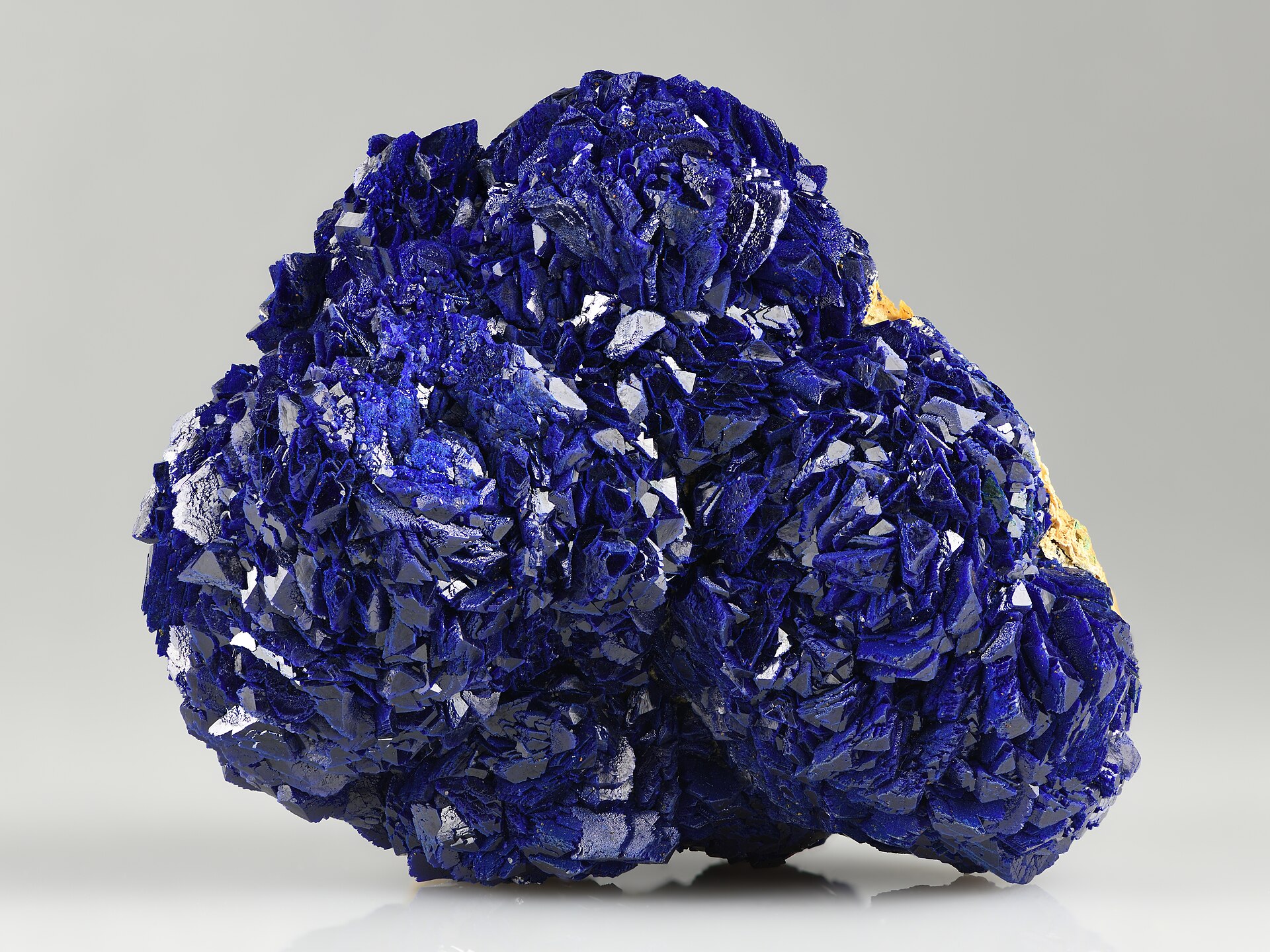
  6. Blue azurite crystals covering a rock matrix with minor malachite, from the New Nevada Lode in La Sal, Utah.
    Chemistry & Materials Science Azurite crystals on matrix from the New Nevada Lode, La Sal, Utah, USA Ivar Leidus, CC BY-SA. Added .
  7. Collage of Hubble and Webb images of the Cat’s Head Nebula, a dark dust pillar in the Carina Nebula where stars are forming.
    Space, Astronomy & Aerospace Cat’s Head Nebula seen by Hubble and Webb ESA/Webb, CC BY. Added .
  8. Paper of the DayMath & Computer Science FoundationsPreprint, not yet peer reviewed

    Positive Dual Certificates for Real Separated Subset Sums: Chamber Optimality of the Conway-Guy and Bohman Sets, and Exact Values up to Eight

    Pick some positive numbers so that all the sums you can make from them differ by at least 1: how small can the largest number be?

    Why it matters For sets of up to eight numbers whose sums all differ, allowing fractions does not let the largest number drop below the best whole-number answer.

    This is a version, allowing any real numbers, of a famous Erdős puzzle about whole numbers, and a construction by Conway and Guy is a well-known candidate answer. The author splits the problem into regions where it becomes a straightforward optimization and proves that the Conway-Guy set is the unique best choice within its region for every size. A computer search with exact checks then shows that for up to eight numbers, real numbers do no better than whole numbers; with eight, the largest must be 84.

    Notik, arXiv math.CO, 16 November 2026.

    Read the paper: Positive Dual Certificates for Real Separated Subset Sums: Chamber Optimality of the Conway-Guy and Bohman Sets, and Exact Values up to Eight

  9. Paper of the DaySpace, Astronomy & Aerospace

    Magnetic Reconnection Governs the Entire Lifecycle of Solar Eruptive Magnetic Flux Rope

    Before many solar eruptions, a twisted bundle of magnetic field called a flux rope sits in the Sun's atmosphere, and what makes it suddenly blast outward is still argued over.

    Why it matters Magnetic field lines breaking and rejoining, rather than the instability usually blamed, may be what sets off and powers eruptions on the Sun.

    The usual explanation is an instability that sets in once the rope rises past a certain height, with magnetic reconnection, the breaking and rejoining of field lines, in a supporting role. Using detailed three-dimensional computer simulations, the researchers grew a flux rope and watched it rise past that height without erupting. It erupted only once the current layer beneath it became thin enough for reconnection to begin, and reconnection then supplied most of the push. The authors conclude that, in this model, reconnection builds, triggers and drives the eruption.

    Bian et al., Astrophysical Journal, 16 November 2026. doi:10.3847/1538-4357/aeb375

    Read the paper: Magnetic Reconnection Governs the Entire Lifecycle of Solar Eruptive Magnetic Flux Rope

  10. Paper of the DayPhysicsPreprint, not yet peer reviewed

    Composition-dependent ultralight dark matter detection with a tetrahedral superconducting gravity gradiometer

    Some theories propose that dark matter is an extremely light field that ripples through space and tugs on different materials with slightly different strength.

    Why it matters Detectors designed to sense gravitational waves could also hunt for very light dark matter, simply by making their test masses from two different metals.

    Catching such a tug needs very sensitive instruments, and the researchers calculate that suitable ones are already being designed: superconducting gravity gradiometers, which track tiny differences in how four test masses accelerate and are planned as gravitational-wave detectors on the ground and on the Moon. Making two of the four masses from copper and two from lead would add a dark matter signal to the same readout, with no extra sensor. That signal points along a direction fixed in advance by where the metals sit, which a gravitational wave cannot mimic.

    Oh et al., arXiv astro-ph, 16 November 2026.

    Read the paper: Composition-dependent ultralight dark matter detection with a tetrahedral superconducting gravity gradiometer

  11. Paper of the DayClimate, Energy & Environment

    Seasonal Asynchrony of Microbial Biomass and Respiration Across Terrestrial Ecosystems

    Soil microbes hold carbon in their own cells and release it as they breathe, and climate models usually assume that more microbes means more breathing out.

    Why it matters Soil microbes are most plentiful and most active at different times of year, so their numbers alone are a poor guide to seasonal carbon release.

    Whether that holds through the seasons was unclear. The researchers pooled seasonal measurements from 323 studies and added detailed observations at individual sites. The times of year with the most microbial biomass were often not the times with the highest respiration. Biomass rose and fell with competition from plants, while respiration followed temperature. The authors stress that the evidence is correlational, but say models of how soils release carbon should treat the two separately as seasonal swings in climate grow.

    Luo et al., Global Change Biology, 16 November 2026. doi:10.1111/gcb.71203

    Read the paper: Seasonal Asynchrony of Microbial Biomass and Respiration Across Terrestrial Ecosystems

Monday 16 November

  1. Paper of the DayAI & Machine LearningPreprint, not yet peer reviewed

    Goal Encoding in LLMs

    When a language model works through a task with several steps, does it hold a goal internally before it acts?

    Why it matters A language model's next intended step can be located in a few internal components, read out in plain words, and transplanted to trigger the same action.

    The researchers gave models coding tasks made of several sub-tasks and looked inside. They found the next sub-goal recorded in the output of a small set of attention heads, the components a model uses to pull in information from earlier text, and could read it out in plain words. Moving that signal into a different setting, such as another programming language, triggered the same operation there. Because such a model cannot carry an internal state forward for long, the authors propose that it keeps re-reading the goal from its instructions and checking progress, an idea they test with targeted experiments.

    Sharma et al., arXiv cs.AI, 12 November 2026.

    Read the paper: Goal Encoding in LLMs

  2. Paper of the DayChemistry & Materials Science

    Ultra‐Stable Phosphide Barrier Layer for Thermoelectric Bismuth Telluride

    Bismuth telluride is a widely used material for devices that turn a temperature difference directly into electricity, but generators built from it have been held back by the lack of a reliable barrier layer, the thin coating that keeps the material from reacting where it is joined to other parts.

    Why it matters Generators that turn heat into electricity with bismuth telluride gain a nickel phosphide barrier layer that stayed stable for 90 days at about 250 °C.

    The researchers propose a family of compounds called metal phosphides and pick out nickel phosphide. It reacts very little with bismuth telluride, nickel moves through it slowly, and it bonds strongly at the atomic scale. The joint stayed stable for 90 days at about 250 °C, the longest reported for any such barrier. A test generator built with it turned up to 6.9% of the heat into electricity.

    Chen et al., Advanced Materials, 15 November 2026. doi:10.1002/adma.75713

    Read the paper: Ultra‐Stable Phosphide Barrier Layer for Thermoelectric Bismuth Telluride

  3. Paper of the DayPsychology & Cognitive SciencePreprint, not yet peer reviewed

    Environmental Preference and Context-Supported Episodic Recall

    Do people remember things better when they come across them in places they like?

    Why it matters People remembered more of what they saw in virtual places they personally liked; a general taste for nature made no difference, in a study of 60 people.

    Little research had looked. Here, 60 volunteers explored four virtual environments, some urban and some natural, some regular in layout and some irregular. They were then tested on what they remembered, straight away and after a delay, and asked which places they liked. A general liking for nature or for orderly spaces made no difference to memory. But in tests that used the setting as a cue, people recalled more objects from the particular environments they preferred. The authors suggest that how a place affects the mind may depend on how each person feels about it, not only on its design.

    Huynh et al., PsyArXiv, 15 November 2026. doi:10.31234/osf.io/dxa2h_v9

    Read the paper: Environmental Preference and Context-Supported Episodic Recall

  4. Paper of the DayAI & Machine LearningPreprint, not yet peer reviewed

    Negative-Only Policy Optimization for One-Sided Verifiable Rewards

    One way to train AI models is to let them attempt problems and reward the answers an automatic checker confirms as right.

    Why it matters AI models can be trained to improve even when automatic checks can only catch wrong answers and never confirm right ones, by learning from the failures alone.

    In many real cases no such checker exists: cheap tests, like a handful of unit tests for code, can prove an answer wrong but cannot prove it right. Rewarding everything that passes then teaches the model shortcuts that slip through the tests. The authors propose learning only from answers known to be wrong: the model is steered away from confirmed failures, and answers that pass are treated as unknown. On coding, logic and maths benchmarks the method solved more problems than existing approaches, and the gain held when it was carried over to other benchmarks.

    Xu et al., arXiv cs.LG, 12 November 2026.

    Read the paper: Negative-Only Policy Optimization for One-Sided Verifiable Rewards

  5. Paper of the DayTech & EngineeringPreprint, not yet peer reviewed

    Implementation of a 1D Gaussian-modulated CV-QKD under finite-size parameter estimation

    Quantum key distribution lets two parties share a secret encryption key using light, with security that rests on physics rather than on hard mathematics.

    Why it matters A simpler way to share encryption keys using quantum light delivered 0.364 megabits per second over 12 km of ordinary optical fibre.

    A leading version encodes the key in two properties of a light wave, which places heavy demands on the sending equipment. Encoding in only one property is simpler, but a complete working system had been hard to build. The researchers built one, running over 12 km of ordinary optical fibre with separate lasers at each end and the full chain of processing needed to distil a secure key. It produced 0.364 megabits of secret key per second under realistic assumptions about limited data. That figure shows what the simpler design costs in performance.

    Nascimento et al., arXiv quant-ph, 12 November 2026.

    Read the paper: Implementation of a 1D Gaussian-modulated CV-QKD under finite-size parameter estimation

  6. Paper of the DayBiology & EcologyPreprint, not yet peer reviewed
    Parental effects can be transmitted through the rhizosphere microbiome

    Plants can pass on the effects of what they lived through, such as crowding by neighbours, to their offspring.

    Why it matters In a common reed, parents that faced competition had offspring with different root microbes, which may account for part of how the offspring grew.

    Known routes include chemical marks on DNA; whether the microbes around the roots are another route was not known. The researchers grew eight genetic lines of common reed with or without a competing species, then raised their offspring in identical conditions. Offspring of parents that had faced competition grew in a more cautious, resource-saving way. They also had different communities of bacteria and fungi around their roots, and statistical modelling suggested these microbes may explain part of the change in the offspring. Parental experience may therefore shape the next generation through soil life as well as directly.

    Chen et al., bioRxiv ecology, 14 November 2026. doi:10.64898/2026.11.12.766069

    Read the paper: Parental effects can be transmitted through the rhizosphere microbiome

  7. Paper of the DayMath & Computer Science FoundationsPreprint, not yet peer reviewed

    Combinatorial Bernoulli Factories with Polynomially Many Coins

    Suppose you have coins whose odds are unknown and want to use them to make a random choice among complicated options, such as ways of pairing people up, that reflects those odds exactly.

    Why it matters Coins with unknown odds can drive a random choice among arrangements, such as pairings, that matches those odds exactly, now with far fewer flips.

    A procedure that does this is called a Bernoulli factory. An earlier one could need an astronomical number of coin flips. The authors give one algorithm, covering every problem where such a procedure can exist, whose expected number of flips grows at a manageable rate with the size of the problem and with how lopsided the coins are. For pairings of n items it needs roughly n to the eighth power flips, where the earlier method needed at least n to the power 2n minus 1.

    Leme et al., arXiv cs.LG, 12 November 2026.

    Read the paper: Combinatorial Bernoulli Factories with Polynomially Many Coins

  8. Paper of the DaySpace, Astronomy & AerospacePreprint, not yet peer reviewed

    Effects of Lensing by Sgr A* on Semicoherent Searches for Continuous Gravitational Waves. I. Signal Model and Mismatch Studies

    Spinning neutron stars are expected to give off faint, steady gravitational waves, and astronomers search for them toward the centre of the Milky Way.

    Why it matters The Milky Way's central black hole would distort gravitational waves from neutron stars behind it in ways current searches leave out of their models.

    For a star behind the giant black hole there, gravity would bend the waves along two paths, and the two copies would overlap and interfere. As the star moves, the interference shifts in ways the search templates leave out. The authors added simulated signals, with and without this effect, to noise and ran a standard search on them. Magnification helped detection, fast sideways motion took some of the gain away, and faint signals were affected more than strong ones. Limits from such searches therefore cannot simply be rescaled; the full distorted signal has to be simulated.

    Sharma et al., arXiv astro-ph, 12 November 2026.

    Read the paper: Effects of Lensing by Sgr A* on Semicoherent Searches for Continuous Gravitational Waves. I. Signal Model and Mismatch Studies

  9. Paper of the DayPhysicsPreprint, not yet peer reviewed

    Circular phonons generate negligible magnetization in insulators

    Laser light can make the atoms in a crystal move in tiny circles, and some experiments have suggested that this motion turns a non-magnetic material into a strong magnet.

    Why it matters Atoms set circling by laser light do not turn silicon carbide into a strong magnet, according to a direct measurement of the magnetic field outside the crystal.

    The evidence was indirect: it came from how the crystal twisted light passing through it, which can be read in more than one way. Here the researchers also measured the magnetic field just outside a silicon carbide crystal while driving it with intense infrared light. The twisting of light was as large as in earlier reports, but the field outside showed that any magnetism was below 0.001 tesla, far too small to explain it. Whatever twists the light, it is not a large magnetization.

    Wu et al., arXiv cond-mat, 12 November 2026.

    Read the paper: Circular phonons generate negligible magnetization in insulators

  10. Paper of the DayClimate, Energy & Environment

    Temperature-Dependent Decay of Infectivity of Infectious Salmon Anemia Virus (ISAV) in Raw Seawater

    Infectious salmon anemia virus, a distant relative of the flu virus, threatens salmon farms worldwide and also wild fish.

    Why it matters A virus that threatens farmed and wild salmon loses its ability to infect sooner in warmer seawater, which shortens how far it can spread between fish.

    Controlling it depends on knowing how long the virus stays dangerous once it is loose in the sea. The researchers kept the virus in natural seawater at five temperatures from 4 to 17 °C and, after set times, tested whether it could still infect young salmon. The warmer the water, the faster the virus lost its ability to infect. In a model of how the virus drifts, the average distance over which fish could be exposed fell by about 40% as the sea warmed from 4 to 17 °C. The findings bear on how salmon farms guard against the disease.

    Kannimuthu et al., Environmental Science & Technology, 15 November 2026. doi:10.1021/acs.est.5c16253

    Read the paper: Temperature-Dependent Decay of Infectivity of Infectious Salmon Anemia Virus (ISAV) in Raw Seawater

  11. A thin crescent Moon with Venus just below it rises over the Andes at dawn, seen from Paranal Observatory in Chile.

    Space, Astronomy & Aerospace A thin Moon and Venus rising over the Andes at dawn ESO, CC BY. Added .
  12. Webb view of protostars and outflows near the star cluster IC 348, including HH 797 and the propeller-shaped HH 211.
    Space, Astronomy & Aerospace Herbig-Haro objects HH 797 and HH 211 near the star cluster IC 348 ESA/Webb, CC BY. Added .