
STEM Synapse

Latest in STEM

Friday 13 November

  1. Paper of the DayAI & Machine LearningPreprint, not yet peer reviewed

    Unbundling Multimodal Vision Encoding

    AI models that work with both images and text differ in how they take in a picture.

    Why it matters Models that handle images and text did not need a vision component trained in advance, only a part of the model devoted to images, in a matched comparison.

    Most pass it through a separate vision component trained beforehand; some train that component together with the language model, and some drop it. Published models also differ in data, design and computing budget, so comparing them cannot show which choice matters. Here every model was trained from scratch on the same data with the same computing budget. A vision component trained jointly did as well as a pre-trained one, so the advance training was not needed. What mattered was having part of the model devoted to vision: models without it fell behind even when enlarged to match.

    Brown et al., arXiv cs.LG, 12 November 2026.
    Read the paper: Unbundling Multimodal Vision Encoding

  2. Paper of the DayTech & EngineeringPreprint, not yet peer reviewed

    Lazare, veni foras: Reprogramming Dormant Neurons to Backdoor AI Agents

    AI agents increasingly run for hours unattended with wide access to a computer, so a tampered model is a security risk.

    Why it matters Editing fewer than ten internal units of an AI model, with no retraining, can plant a hidden trigger for an attacker, though most such edits were detected.

    This preprint shows how little tampering it takes. The method edits fewer than ten of a model's unused internal units, with no retraining, so that when a chosen trigger text appears, the model outputs a command picked by the attacker. In one model, changing seven units out of more than 12,000 set off the command in at least 98.8% of test runs containing the trigger, and in none of the normal runs checked. Two other models were just as vulnerable. The edits leave traces: automated defences flagged 91.4% of tampered models, while wrongly flagging 9.7% of clean ones.

    Zeng et al., arXiv cs.CR, 11 November 2026.

    Read the paper: Lazare, veni foras: Reprogramming Dormant Neurons to Backdoor AI Agents

  3. Paper of the DayBiology & Ecology

    The importance of genes does not predict their mutation rate

    Mutations are usually treated as random, striking genes without regard to how much they matter.

    Why it matters How important a gene is does not predict how often it mutates in E. coli or yeast, undercutting the idea that evolution shields its most vital genes.

    Some researchers have claimed otherwise: that evolution has arranged for important genes to mutate less and for genes needing rapid change to mutate more. Those claims have been disputed. This study reanalysed records of mutations accumulating in normal strains of the gut bacterium E. coli and of baker's yeast, taking other influences into account. In E. coli, heavily used genes may mutate slightly less, but yeast shows no such pattern. In neither species do essential genes, or genes for abundant proteins, mutate less. Where a gene sits relative to DNA copying made no difference in E. coli either.

    Radrizzani et al., PLOS Biology, 12 November 2026. doi:10.1371/journal.pbio.3004089
    Read the paper: The importance of genes does not predict their mutation rate

  4. Paper of the DayMath & Computer Science FoundationsPreprint, not yet peer reviewed

    The Tournament Equilibrium Set Is PSPACE-Complete, Even under Hereditary Uniqueness

    Some voting rules pick winners from head-to-head contests: for every pair of candidates, which would a majority prefer?

    Why it matters For a voting rule proposed in 1990, checking whether a given candidate wins is now proven extremely hard to compute, even where finding some winner is quick.

    One such rule, proposed by Schwartz in 1990, judges each candidate by the candidates that beat it, in a definition that refers back to itself. Deciding whether a given candidate is among its winners was known to be hard to compute, but not exactly how hard. This paper settles it: the problem belongs to a class believed to be far beyond efficient computation, and stays that hard even under a condition Schwartz conjectured always holds. Yet in the very cases built to be hard, one winner can be found quickly. Finding some winner is easy; confirming a particular one is not.

    Dickey et al., arXiv cs.CC, 12 November 2026.

    Read the paper: The Tournament Equilibrium Set Is PSPACE-Complete, Even under Hereditary Uniqueness

  5. Paper of the DaySpace, Astronomy & AerospacePreprint, not yet peer reviewed

    JWST Rocky Worlds DDT Observations of LTT 1445 A b and c in Secondary Eclipse Using MIRI/F1500W

    Do small rocky planets orbiting red dwarfs, the most common kind of star, keep their atmospheres?

    Why it matters The nearest rocky planets seen crossing a small red star look like bare rock, narrowing down where such planets lose their atmospheres.

    The James Webb Space Telescope is testing this by measuring the heat such planets give off. This study looked at two rocky planets of LTT 1445 A, the nearest system of its kind, about 22 light-years away. Both gave off as much heat as dark, bare rock would. For planet b, the data limit the surface pressure to about a tenth of Earth's or less, so it has no substantial atmosphere; planet c is less certain. Planet b sits close to the predicted dividing line between planets that keep their air and those that lose it, so the result helps fix that line.

    Ih et al., arXiv astro-ph, 12 November 2026.
    Read the paper: JWST Rocky Worlds DDT Observations of LTT 1445 A b and c in Secondary Eclipse Using MIRI/F1500W

  6. Paper of the DayHealth & BiomedicalPreprint, not yet peer reviewed

    Sub-Threshold Stochastic Vibration Improves Fingertip Tactile Sensitivity in Stroke Survivors and Healthy Adults, with Source-Localized EEG Evidence for Cortical Network Reorganization in Healthy Adults

    The sense of light touch often fades with age and after a stroke.

    Why it matters Vibration too faint to feel sharpened the sense of touch in the fingertips of both healthy adults and stroke survivors, though only 24 people were tested.

    This preprint tested an odd-sounding remedy: adding random vibration too weak to feel. Nineteen healthy adults and five stroke survivors had a device on one fingertip that delivered a steady vibration, with or without the faint random vibration added, and the researchers measured the weakest steady vibration each person could detect. With the faint random vibration, every participant detected weaker vibrations than before; sensitivity improved by up to 19 times in healthy adults and up to 4 times in stroke survivors. Brain recordings in the healthy group showed stronger coordination between brain regions, especially frontal ones. Only 24 people took part.

    Ashfaque et al., medRxiv, 12 November 2026. doi:10.64898/2026.11.10.26367694

    Read the paper: Sub-Threshold Stochastic Vibration Improves Fingertip Tactile Sensitivity in Stroke Survivors and Healthy Adults, with Source-Localized EEG Evidence for Cortical Network Reorganization in Healthy Adults

  7. Paper of the DayPhysicsPreprint, not yet peer reviewed

    Long-lived light-driven bimagnons at finite momentum in NiO

    In a magnet, the tiny magnetic moments of atoms can ripple in waves called magnons.

    Why it matters Light-driven pairs of magnetic ripples in nickel oxide last about 28 trillionths of a second, over a hundred times longer than earlier reports.

    In some materials light can create these ripples in linked pairs, but how long a pair survives was unclear; earlier measurements suggested they fall out of step within 200 femtoseconds, millionths of a billionth of a second. The researchers hit nickel oxide with pulses of infrared light and followed what happened using ultrafast X-ray pulses. The material's overall magnetic order stayed intact. A signal from the paired ripples built up over about 4 picoseconds, then faded with a characteristic time of 28 picoseconds, more than a hundred times longer than the earlier figure. Such pairs can persist far longer than had been thought.

    Yang et al., arXiv quant-ph, 12 November 2026.
    Read the paper: Long-lived light-driven bimagnons at finite momentum in NiO

  8. Comet Hale-Bopp above a tree near Pazin in Istria, Croatia, with the Andromeda Galaxy faintly visible to the lower right of the comet.
    Space, Astronomy & Aerospace Comet Hale-Bopp above a tree in Istria, Croatia Philipp Salzgeber, CC BY-SA. Added .
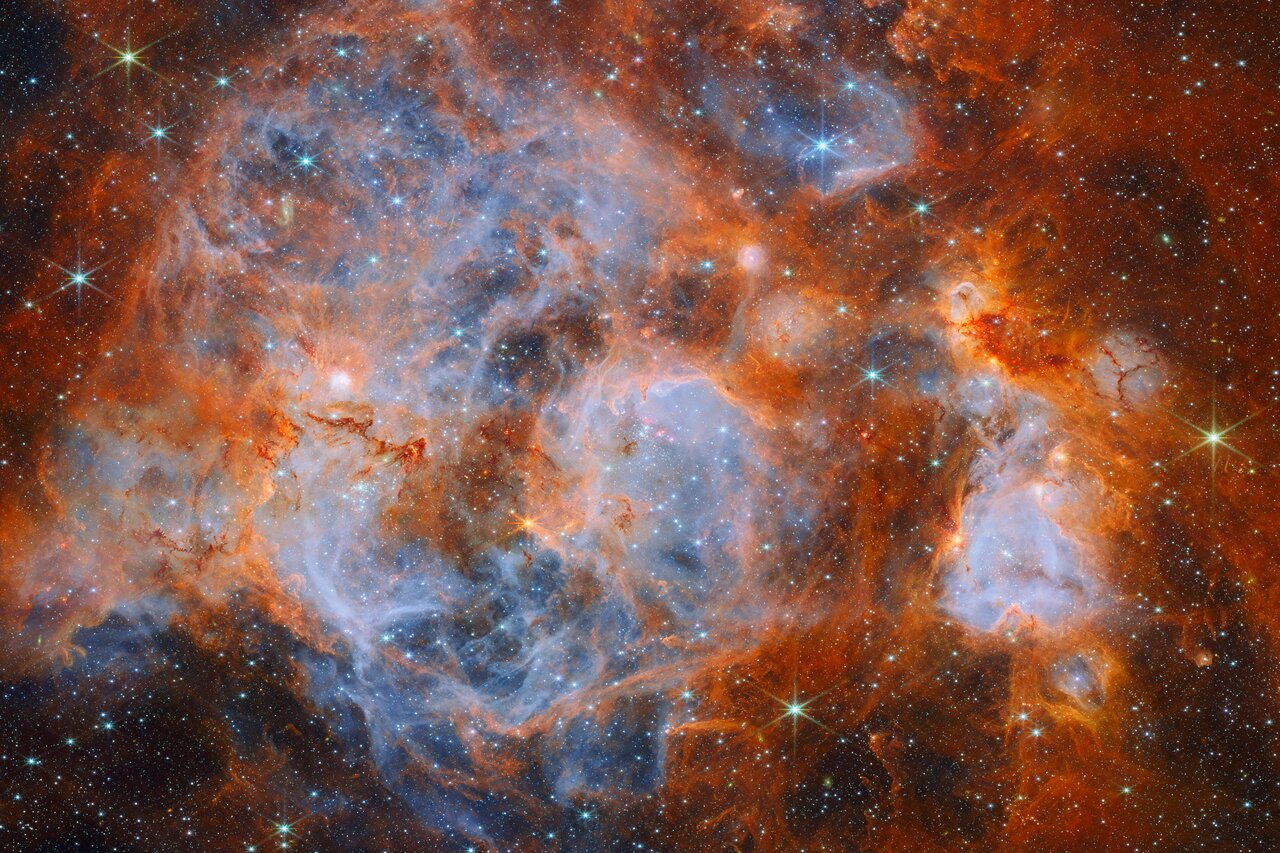
  9. Webb view of N159, a star-forming region of dense gas clumps in the Large Magellanic Cloud, about 230 light years across.
    Space, Astronomy & Aerospace Stars brewing in a nebulous cauldron ESA/Webb, CC BY. Added .